A weekend 'champing' in Stansted Mountfitchet, 14/15 September 2019

Champing was one of the things on our bucket list of things to do and the lovely church at Stansted Mounfitchet fitted the bill nicely. Being a nice easy drive but also far enough away to feel like we were going somewhere new.

We began the weekend early on Saturday and had planned a long 12km walk around Hatfield Forest. This was a nice new area to explore, especially as I had a pair of Ravens 'gronking' over the SW section the the forest plus c6 Nuthatches, Great Spotted Woodpecker and Coal Tits plus Comma, Speckled Wood, Small White, Small Heath, Brimstone and Red Admiral.

Sunday was spent at Audley End Hall near Saffron Walden where a Red Kite and a Common Buzzard were up together and a late Painted Lady was in the walled garden. While having a picnic lunch a sharp-eyed Belinda spotted a tiny ladybird in the grass which turned out to be a 22-spot Ladybird and a new species for me.

On the way home a Little Owl was near Winfarthing.

22-spot Ladybird

St Mary the Virgin, Stansted Mountfitchet

      'Champing'

Ivy Bees, 12 September 2019

I had business to take care of in Thetford yesterday and was able to combine it with a stroll around the town and along the river. Most pleasing were a large number of Ivy Bees in some town centre formal gardens/tennis courts and 3 Muntjac at point blank range as I looked over a wall. Along the river the odd Common Emerald Damselfly were still lingering on. Earlier a very docile female Large White was sheltering from the drizzle in Pulham Market while I was trying to work.


Ivy Bees

Large White

Meadow Saffron, Martin's Meadows, Suffolk, 7 September 2019

At the start of the year I made a 'hit list' of things I wanted to see over the next couple of years. I've made quite good progress this year and Meadow Saffron (aka Autumn Crocus) was the last of my  doable targets for this year. Martin's Meadows SWT in the middle of nowhere is a lovely little reserve and luckily Meadow Saffron is common there. Indeed I found hundreds in all 3 meadows, ranging from the normal pink/mauve through to completely white specimens. There was plenty of Devils-bit Scabious and Black Knapweed still in flower plus 4 butterfly species on the wing - Small Heath, Common Blue, Speckled Wood and Small White.  While there we 'scrumped' a few apples and pears from the orchards there. Well, they were dropping to the floor and would have gone to waste! It was lovely to note the old english varieties - Lady Sudely, Golden Noble, Horringer Catshead, Warner's King and Dumdow's Seedling as well as an old Medlar tree full of fruit.


Meadow Saffron

Devils-bit Scabious

Apple and pear haul!

  Medlar

The rest of the day was spent on a walk around the UFO trail in Rendlesham Forest. Apart from the odd Grayling along the forest rides it was pretty uneventful but we needed the exercise!

   Grayling

Sri Lanka Tour, 10-20 December 2019 - one space left!

My friend AbdulRahman Al-Sirhan, a birding guide in Kuwait who I have had the great pleasure to bird with on numerous occasions is running a small group tour to Sri Lanka this December. Naturally I am signed up to go and at the moment AbdulRahman is looking for one more person to join us and make a 4 person tour party. At just 1100 Euros (plus flights) for the trip this is a very reasonably priced tour targeting the endemics and other avian goodies that the country has to offer. Additional good news is that the Sri Lankan Govenment has waived visa fees for the next 6 months too!

The tour will be guided by the excellent local guide Prasanjith Caldera from Walk-With-Jith.

Full details of the trip can be found by clicking the link below

https://www.birdsofkuwait.com/blog/sri-lanka-tour-december-2019/?fbclid=IwAR1dzIM6PMtaNVAZtDbuaUDGPS6C4IsQoa6fKE1uLl70A9y-0dCPi95N1D8

So, if you fancy seeing Serendib Scops Owl, Chestnut-backed Owlet, Sri Lankan Scaly Thrush, Legge's Flowerpecker, Sri Lanka Scimitar Babbler, Yellow-eared Bulbul, Sri Lanka Blue Magpie and a host of others please let AbdulRahman know


Horsey & Winterton, 27 August 2019

With the hot weather about to break it was nice to knock off work mid-afternoon and head up to the coast. It felt like last chance saloon in my quest for a certain damselfy in the county as the flight season is just about over.

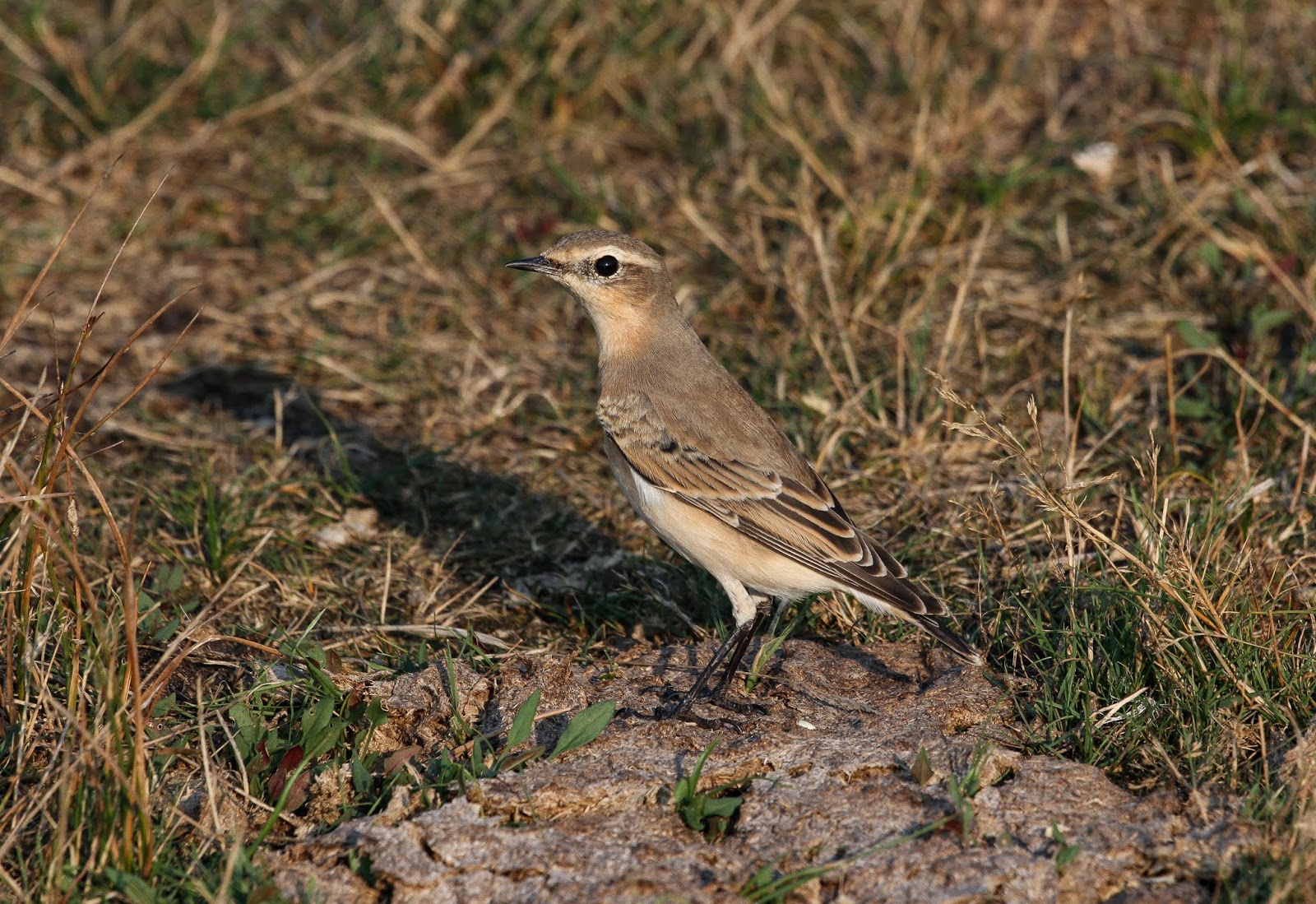
On the sweaty walk to the location no less than 7 Whinchats, 3 Wheatears and a family party of Stonechats livened things up. As did a single late Dark Green Fritillary.

Reaching the pool I flushed 2 Common Sandpipers and then spent a good 2 hours searching the margins. Amongst a good few Blue-tailed Damselflies I found one strikingly orange specimen. I battered it with my camera and have since been able to categorically id it as a female Scarce Blue-tailed Damselfly of the orange 'aurantiaca' form - bingo! Wow, has this, my 34th species of odonata for Norfolk lead me on a merry dance!

With a little time (if not energy!) to spare I popped to Winterton and in some bushes SE of the totem pole met Jus, Chris B and Chris S. And with help from some fieldcraft got some nice views of the Wryneck to round off a splendid evening.


Wheatears

Whinchat

Dark Green Fritillary

  Scarce Blue-tailed Damselfly (fem, form aurantiaca)

East Sussex & Kent for Long-tailed Blues and much more, 25 August 2019

We had been planning a day out in Kent for a few weeks but with the discovery of Long-tailed Blue butterflies in East Sussex our planned day began to take shape nicely.

Leaving Norfolk at 07.45 we were down in Brighton in time for the warmth of the day to have built up. Whitehawk Hill in suburban Brighton was our destination and sure enough, in an area of rough grassland and bushes close to the TV mast we found a couple of other guys and more importantly 2 male Long-tailed Blues! One was seen on numerous occasions, whizzing backwards and forwards with an amazingly fast and jerky flight. Luckily it did settle a few times allowing some photographs.

We then moved on through the Brighton traffic to the town of Lancing to the west. Here, looking through a fence in the corner of the Asda carpark beside the railway line we immediately got onto 2-3 female Long-tailed Blues along a line of flowering Broad-leaved Everlasting Pea. Again they performed well prospecting egg-laying spots although they were that little bit distant for decent pics.


Long-tailed Blue (male)

 Long-tailed Blue (female on Broad-leaved Everlasting Pea)

We had spoken to a guy at Whitehawk Hill who tipped us off about a couple of nearby sites. The first of those was Steyning Rifle Range (aka Steyning Downland Project) so we duly headed off there next. Despite it being supposedly after the best time to see them (we arrived at 14.20) we scored with a couple of Brown Hairstreaks within about half an hour. Some good perched views through the bins but nothing I could get my camera on.


 Steyning Rifle Range

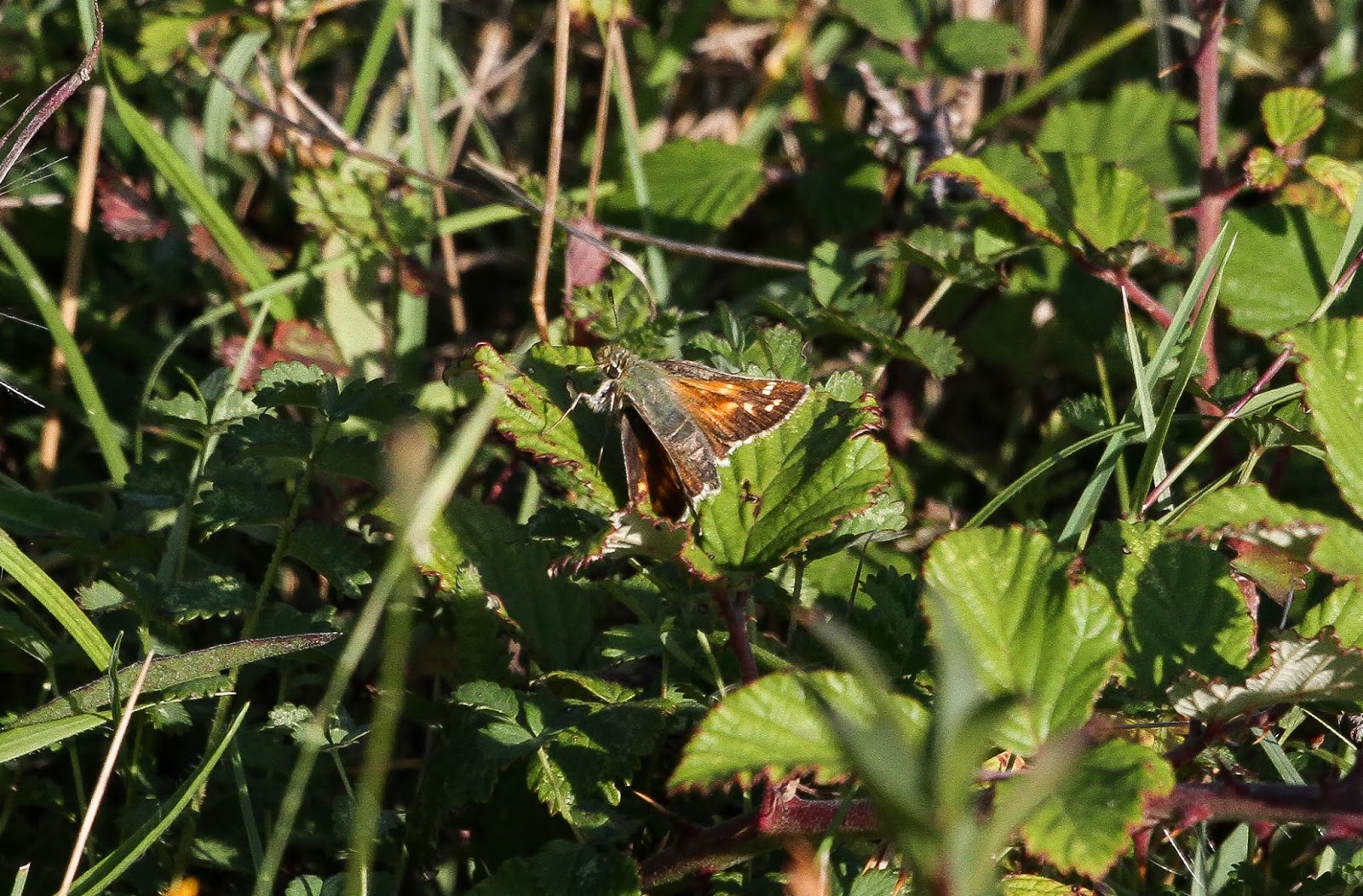
The other site we were told about was Malling Down, just outside Lewes. After some difficulty finding a place to park we walked up the path from the west and out onto the impressive down. And it took me about 5 minutes to get onto a female Silver-spotted Skipper! She was quickly followed by a male which sat still for a while allowing some pics and for us to note it was one of the dark variety where the ground colour to the underwings is a dark brown suffused with green. A couple each of Adonis Blue and Chalkhill Blue plus some nice plants - Carline Thistle, Dwarf Thistle, Wall Cotoneaster and Small Scabious had us leaving the site in fine spirits for our trek across to north Kent.

Silver-spotted Skipper (male of the dark form)

Silver-spotted Skipper (female)

Carline Thistle

 Malling Down

The drive was surprisingly easy and we arrived at Queendown Warren, our penultimate site with about 20 minutes of decent light left. Luckily we found loads of Autumn Ladies Tresses in double quick time with the bonus of Autumn Gentian.


Autumn Ladies Tresses


 Autumn Gentians

After an entertaining fish supper in the High Street in Sheerness (dining alfresco on the pavement seating we were 'treated' to the drunken antics of 2 girls who were keen to procure some chips for a quid!) we headed to the dock area and another 'high street'. What had been our main target for the day had to be left until last and after dark - European Yellow-tailed Scorpions. Here, using 2 UV torches Jus had purchased we saw about 25 of these marvellous creatures on and in the old dock wall. Apparantly a population of 15-20,000 prevails and has been there for 250+ years!


         EuropeanYellow-tailed Scorpions

Educational Damselfly! Winterton, 24 August 2019

Despite spending some while up at 'the' pool in Winterton North Dunes looking for Scarce Blue-tailed Damselfy with Murray, Lynette and 2 others we failed to find any. There was one strange damsel that we initially thought was one but examining photos have revealed it to be a strange thing indeed. After much discussion on social media it's been agreed it's a female Blue-tailed Damselfly with atypical blue markings on segment 7 (which shouldn't have amy blue on the top). 2 Wasp Spiders nearby were less controversial!  Birdwise 3 Whimbrel flew south, a couple of Chiffchaffs and a small handful of Stonechats was about it.


Abberant female Blue-tailed Damselfly


Wasp Spiders

Black Guillemot at Cley, a Norfolk bogey bird falls! 22 August 2019

Black Guillemot has long been a bogey bird of mine and arguably the 'commonest' bird I'd never seen in the county.
So, with a confiding juvenile bird having been showing most of the day off Cley Beach carpark I dashed up there this evening and the bird was present on arrival for a bit of 'easy birding'! About 30 yards offhsore it showed very well despite diving frequently. In time it drifted west a few hundred yards, probably with the tide and it was time to quit the scene. Apart from a couple of Fulmars, Sandwich Tern and small groups of Common Terns heading west towards the point it really was just a dirty twitch!

Norfolk bird no.397